

How do I get my children to own the values we’ve raised them with?
To appreciate and understand the effort we’ve put forth as parents for their betterment?
To desire to carry on what we’ve worked so hard to begin, and labored to continue?
These are questions which have turned in my mind from the very early years of parenthood, and remain attendant today. “Legacy” is a hot topic on Substack lately, although it seems a lot of the advice is geared towards People with Lots of Money who want preserve their family’s money in a meaningful way. Some recent events in my personal life have prompted me to examine more deeply the ways we’ve (my husband and I) undertaken to perpetuate our People Without Lots of Money family legacy through our children - in the realms of memory, physical property, and traditions. Of course, my children are not yet grown, so here is my obligatory humble-stumble admitting that most of my advice is not-yet-complete conjecture based on what’s worked for me. However! my husband and I are both people who strongly appreciate family legacy, so I will share the personally relevant characteristics of our upbringings to underscore the factors which we believe led us to have the values we carry today.
I think the conversation about “legacy” leaves a lot of us wondering where to even begin. What can we purpose to carry on, when nothing belongs to us in the first place? So much of the traditional components of culture have been lost over the past decades, or transformed into something unrecognizable. Ways of life. Religion and ritual. Handcrafts and stories. Simple knowledge. There is no family seat, no locale of origin, no ancestral trade, no collection of great grandfather’s books, no tree in the yard from which multiple generations have picked ripe fruit. Progressivism, minimalism, “new money” ideals and anti-family values reign rampant over modern culture, obliterating the former ways of life which naturally led to a retention of legacy. But - here we are, and although our current environment may not be so readily conducive to legacy, it is still possible to attain.
My husband and I both care a lot about family legacy. In fact, it’s one of the principles we agreed upon as a high priority before we were even married. By “legacy,” I mean “building a life which will outlast us.” We married young, but approached the altar with a solid list of shared ideals in which we remain united today. Herein lies a very important component of parenting towards legacy: sharing said goal from the outset - or, as early as possible - between husband and wife. You can’t build upon what isn’t united. If we had chosen to pursue a modern-values lifestyle for the first decade of our marriage, I honestly do not believe we ever would have been able to attain our current status: property-owning parents with a family side business. What led to us minding our legacy began decades earlier, in childhood.
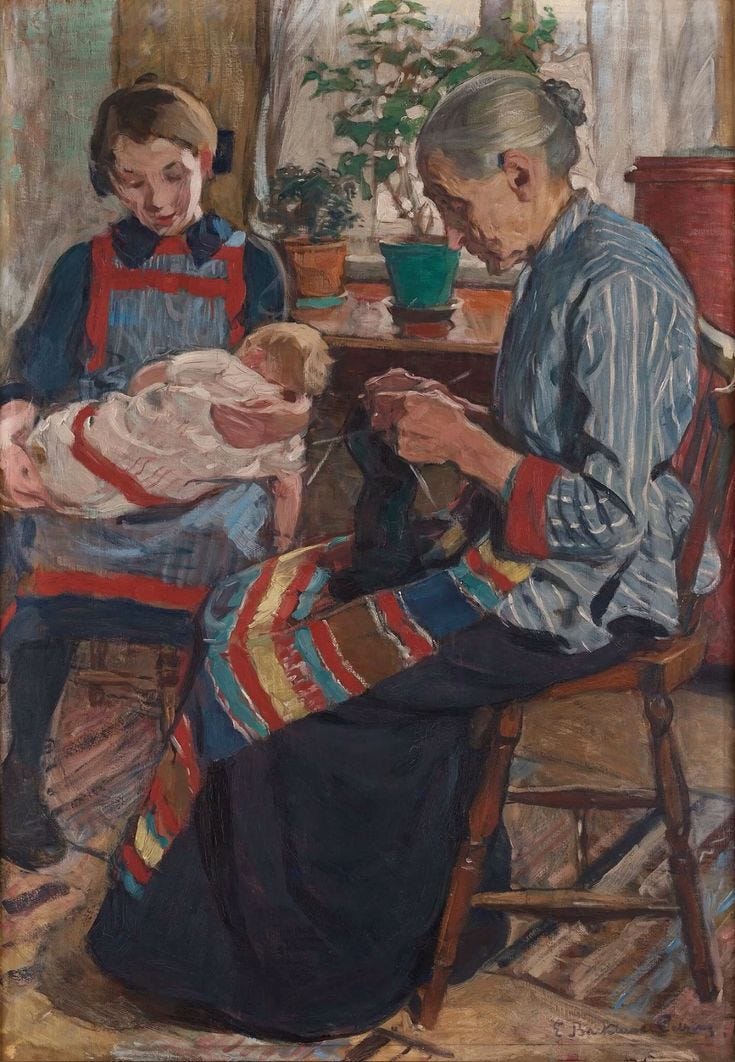
In discussion with my husband regarding our reasons for being who we are today, we both agreed that a huge factor was the large amount of time we spent with our respective grandparents. (Good) grandparents (and other extended family) have this magical effect of both solidifying and broadening a child’s world. Through our extended family, we are comforted by the breadth and closeness of our relations. We learn family history, family recipes, family stories, how to act, how not to act, who lived where and when, who died when and what they liked to do. We learn about those family members’ personal interests and ideas. We integrate, in some form, those ideas, histories, happenings and interests into ourselves and carry them with us as we progress through life. Ideally we will then pass these valuable treasures on to our own children - it’s only natural. I visited with my paternal grandparents very frequently, and I learned a great deal from them. I could not even tell you all the things I have absorbed from my grandparents. About my uncle, who died young of cancer. And the other uncle who died, less young, of the same cancer. The great grandparents’ hobby farm and their life during the Great Depression. Colonial herb gardening, how to set a fancy dinner table, candying violets, colonial era tea service, how to scrub a baseboard with a toothbrush, dried flower arranging, and simple cross-stitch - all knowledge from my grandmother’s personal interests. American quarter horses, presidential history, horseback riding, classical music, restoring antique furniture - interests of my grandfather. My husband spent a lot of time with his grandfather, son of immigrants from Finland, and spent hundreds - if not thousands - of hours at the generational family cabin and land upon which the original immigrant family settled, fixing and building things, rattling around, and especially listening to the clock tick while his grandfather talked for long hours with his brothers who remained living. On paper, to a modern kid, that sounds boring as hell. But time well spent with grandparents is invaluable in building a child’s sense of family history and foundation. We were both blessed to have good grandparents who inculcated traditional ideals of hard work and personal accountability, the kind who didn’t own computers or smartphones and barely turned on the TV. To them, we owe respect and gratitude for what they passed on to us.
An additional element that I consider important in my own formation towards minding my legacy was the infrequent vacations with extended family that I enjoyed throughout childhood and my young adult years. I dimly recall the concrete details of our various trips - to Old Lyme, Connecticut, the New Jersey beach, Florida, California, and Wisconsin - including or meeting aunts, uncles, cousins, grandparents, but I loved being surrounded by family and feeling the happy camaraderie we shared by staying in the same home. My husband took multiple yearly trips to his family’s aforementioned generational cabin, around which extended family members still lived then and do today. In short, we both spent concentrated periods of time immersed in our respective generational family cultures.
It follows that if you’re spending a lot of time with grandparents who don’t use TV, computers, or care about what’s playing on the radio besides Mozart or Jan Sibelius, you will be uniquely inoculated against the meaningless trappings of modern culture. Due to the anti-family values held by most of society today, I firmly believe that one must exist largely outside it - in various ways - in order to retain a sense of purpose towards legacy and tradition. We were made comfortable with a more conservative, simple form of living which did not require our unquestioning adherence to modern ideals. Our own immediate families lived in and participated in a typical modern life but had their own little cultures which did not include much of what was typically considered “cool.” We did not watch the “normal” TV shows, listen to popular music, go to Disneyland, or pursue almost any of the culturally popular ideals at the time. This was not because our parents were fundamentalist religious weirdos; no, they just thought those things were annoying and trashy and wanted to do other things instead. My dad built boats in our garage for fun and took us sailing and skiing. Our family took road trips to historical locations, watched Masterpiece Theater and didn’t buy (much) junk food.1 My husband grew up splitting wood, reading his dad’s collection of midcentury science fiction and fantasy books, and visiting grandparents very frequently - which he was able to accomplish because he was homeschooled. Yes, there was also a lot of screen time, but these anti-modern cultural influences were significant enough to hold their own and bear fruit in later years.
Isn’t it funny how all the ideals pushed upon young people today effectively exterminate much possibility of building a future that outlasts oneself? Not funny at all, really - but when you consider how uncool it is to even be sexually fertile and act upon that fertility by producing children, much less more than two of them, I remain confident in my pronouncement. People are told to leave their place of origin, go to a college far away, take on debt, travel as much as possible, delay marriage, avoid having children, move often in pursuit of a marginally more ideal living situation. Doing these things will mean you’ve “made it” as a modern success story, but they can very often be absolutely antithetical to creating a legacy.
If you raise your child to be of the modern world, they will in all likelihood continue that trajectory into adulthood. If you raise them to value family and legacy, they will retain it. At the very least, they will have a much greater chance of caring about the importance of family given intentional parenting towards that principle. Yes, some people by their nature and temperament will be bound to reject anything their parents teach them, and doggedly pursue their own aims which may be counter to a traditional, family-valuing mindset. But by and large, we become what we were raised to be, one way or another.
That being said, here are the principles I am working from in my efforts to raise children who appreciate their legacy and desire to continue it in their own lives:
Have Something To Perpetuate
Get married and have children. There is no legacy if you have no one to whom you can bestow it upon. Own property, if possible, and hold onto it so you can build value and a sense of place for your children. Take care of your property and make it beautiful and useful, with the next generation in mind.
Belong To A Place
Pick a location and stay there. This doesn’t work if you’re constantly job hopping to the latest up-and-coming city or taken in with “best life syndrome.” Build roots and connections with the local community and other families there.
Know Tangible Things
And teach them to the next generation properly. Physical skills - even hobby skills such as painting, whittling, knitting, and hunting - are all part of your legacy because they become a part of you that is shared with the next generation that follows.
Keep Physical Objects
To a point. I’m not condoning hoarding, but retaining special objects that belonged to family members is a way to keep them alive for yourself and the younger generation. Ideally you will integrate them into a place of real use or a part of your homes interior decor so they can be viewed - but in the very least, they could be stored properly with the intention of intermittent viewing for remembrance’s sake. Photo albums are the easiest way to do this without taking up space you may not have. Also, you can’t retain a visual sense of your family’s history while wholeheartedly throwing yourself into whatever the latest home decorating style is - especially if that style is whitewashed minimalism - so it will force you to develop more of your own taste, which is always a good thing.
Talk About Your Family
Talk about your family in a real way, in a casual way, in everyday conversation. Bring up deceased family members and tell stories about them. Relate the living family members to the members who have passed away. These stories will become your family lore, and help your children connect themselves to farther-flung branches of the family tree.
Have a Family Business or Physical Trade/Activity
Something tangible and lasting to involve your family and children in. Maybe that’s a ritualized extended family group activity, or outing. I knew one Polish family who got together with the cousins and uncles and made sausage the old-fashioned way every year. Other families have a business which can employ and connect multiple members. Some families have a smaller side business - such as carpentry, sewing, or music performance that the children can actually participate in and learn real skills.
Respect Your Own Parents
Respecting your parents does not mean whitewashing their flaws, allowing them to be unhealthily involved in your life, or letting them do whatever they want within your family. It does involve speaking well of them when possible and staying quiet when there isn’t much nice to say. Respecting your parents means you help them when you reasonably can - and maybe even when you reasonably can’t - and give them the honor due for the simple office of parenthood, and the fact that they’ve lived longer than you. Do you want your kids to respect you? Then model it for them, now.
Don’t Be Ashamed Of Your Life
Are you encouraging your children to embrace the modern lifestyle via an underhanded rejection of your own? Do you express gratitude for what you have and who you have? Wendell Berry’s novel Hannah Coulter explores this theme, as the protagonist’s children grow up and move away, abandoning the family farm and their parent’s traditional values. Hannah realizes that they had unwittingly been encouraging their children to leave all along, and regrets she cannot undue past actions. Hannah Coulter is an excellent modern story including the theme of family legacy - I recommend a read for further exploration on this topic.
Legacy is made of people and the connections between them. In fact, I think most of legacy IS just generational connection. Those connections are rooted in places, stories, items, and the very features we bear influenced by family genetics. Ultimately, the greatest way to build a legacy is to create and build connections amongst the family that you do have with the intention to build one of your own, and inculcate a steadfast belief in the importance of family in those members. As for me? I’m making sure my children know about cross stitch, the history of the American west, and are comfortable having the local classical radio station playing in the background. I’m ensuring that they regularly visit that same generational Finnish cabin where my husband whiled away so many thousands of hours. And if we are successful, we will live to see our grandchildren someday learning to love these same cherished things.
Thank you so much for stopping by. I am humbled by your support and words of kindness! If you’d like to follow along, you can subscribe below. Most of my writing is free because, well, I want lots of people to have the opportunity to read it. Paying subscribers help contribute towards our family’s livelihood and ongoing mission to build legacy and tradition in our home.
Blessings,
Emily
If You Enjoyed This Post, You May Also Like to Read:


Cape Cod potato chips and Raisin Bran cereal were as wild as we got, mostly - if you know, you know
Whole heatedly agree. However, we're in a weird position where we are close to both sets of grandparents and could have the potential to cultivate a deep relationship. But their way of thinking is modern and I believe will lead our children away from what this article promotes. So I feel torn/hypocritical in wanting to be cautious with my children's relationship with them.
This was beautiful! It made me think about what we are already doing to preserve value and legacy for our family and areas we can expand our focus. I love considering w my siblings (all married w our own children) how although some of our homes and lifestyles are different there are certain aligning values we got from our own parents that remain.